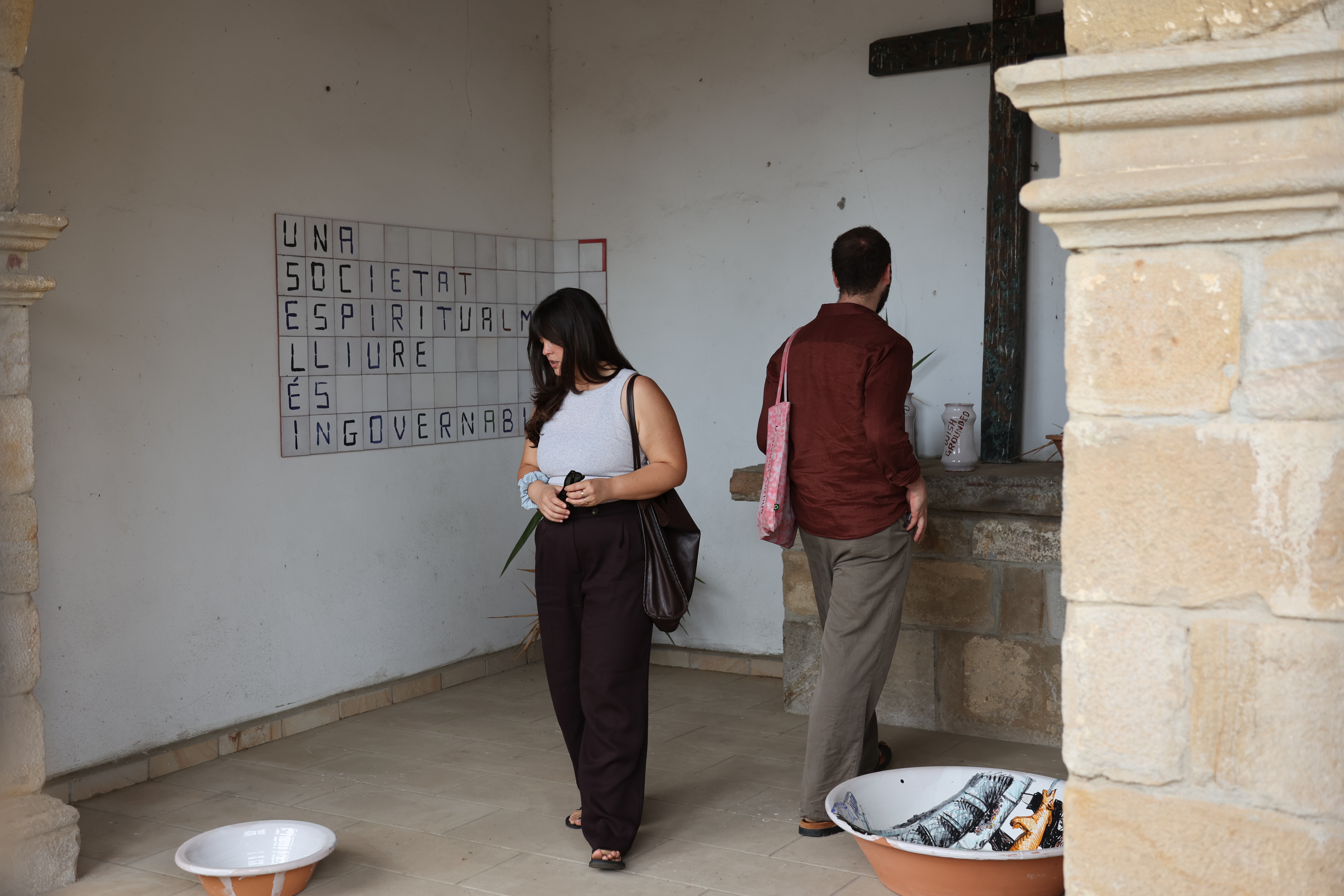
Fernando Renes’s intervention is situated in the Humilladero del Santo Cristo, a devotional architectural structure traditionally located on the outskirts of parish churches. In the contemporary context, its original function, associated with penitence and purification, has given way to seasonal forms of communal use.
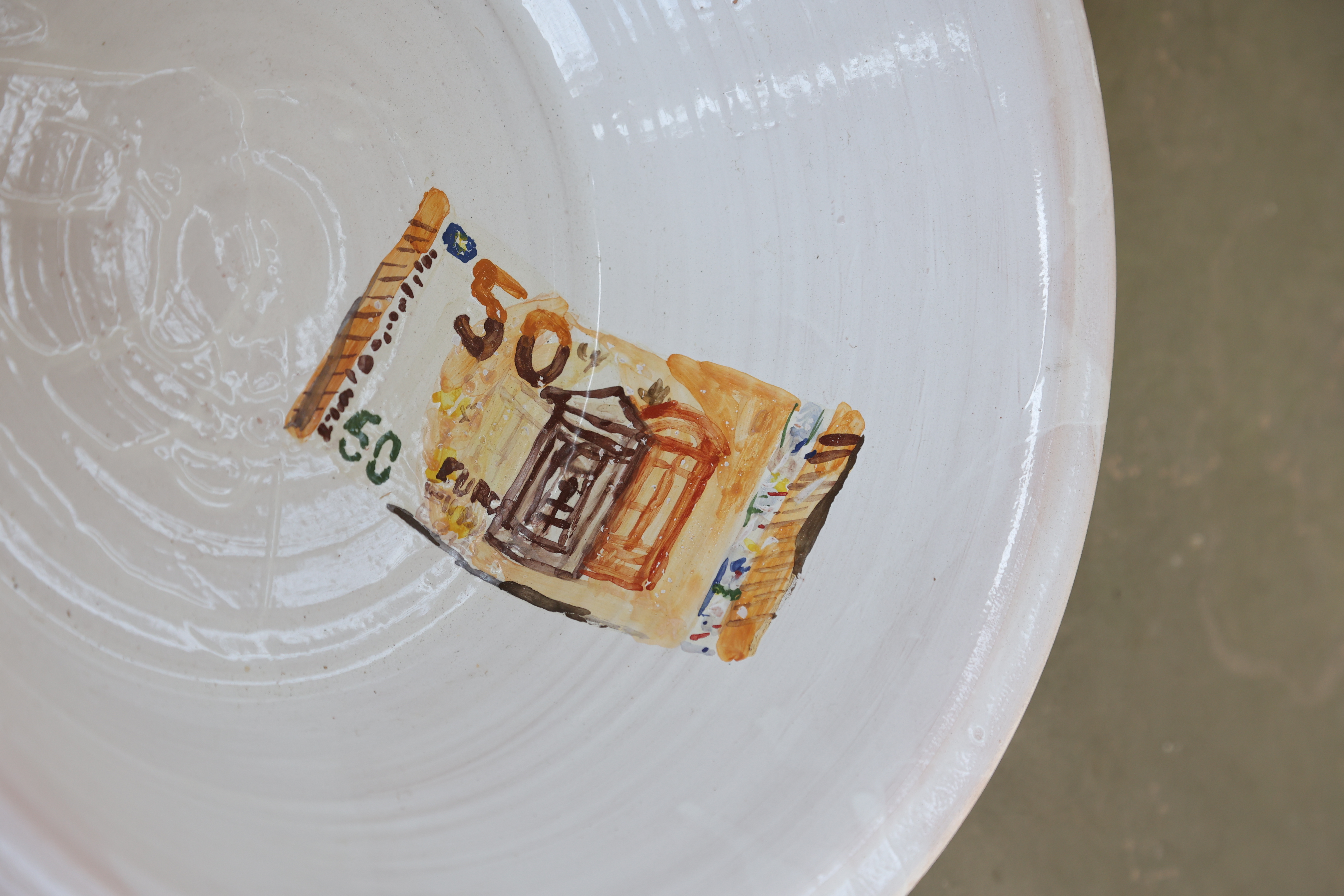
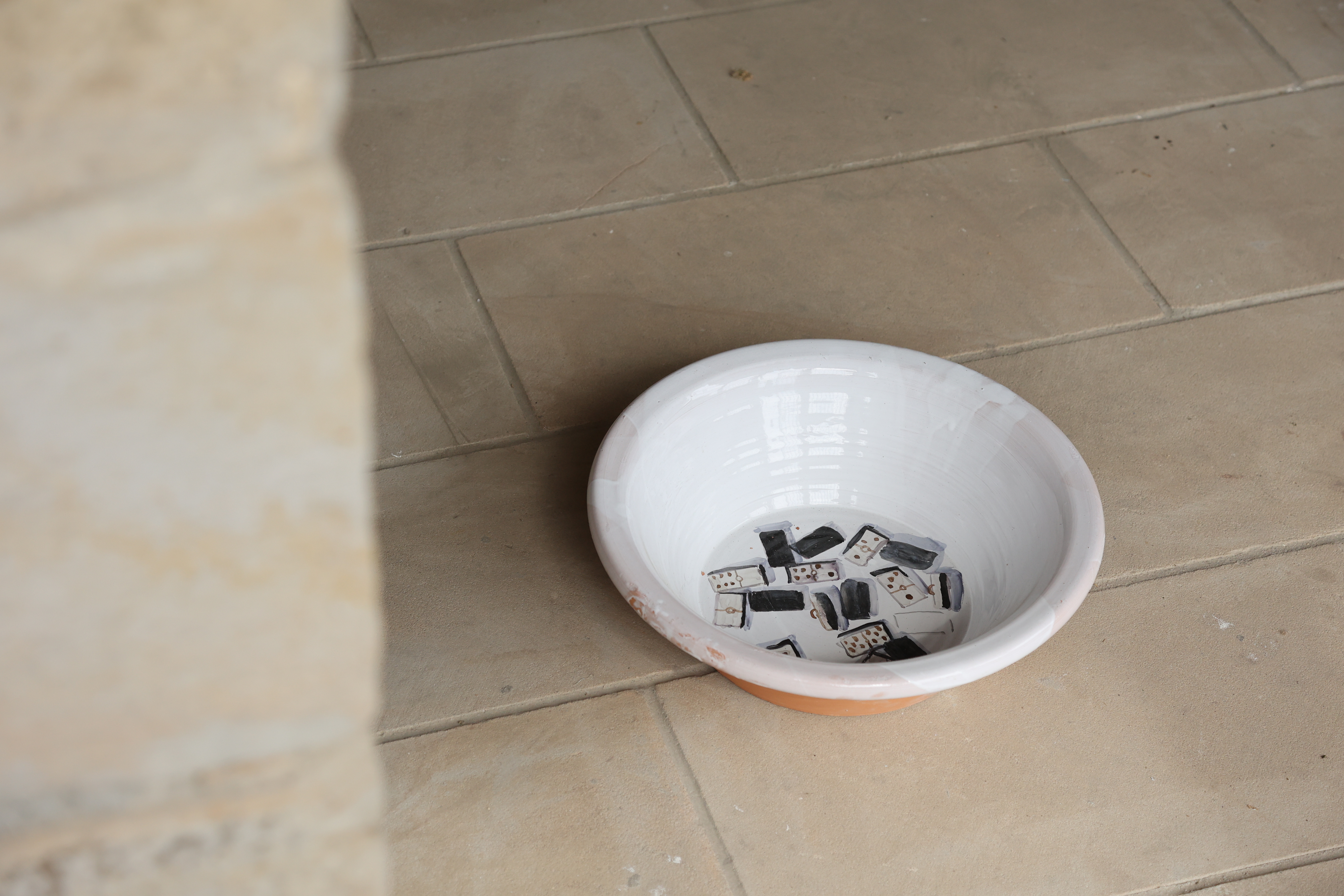
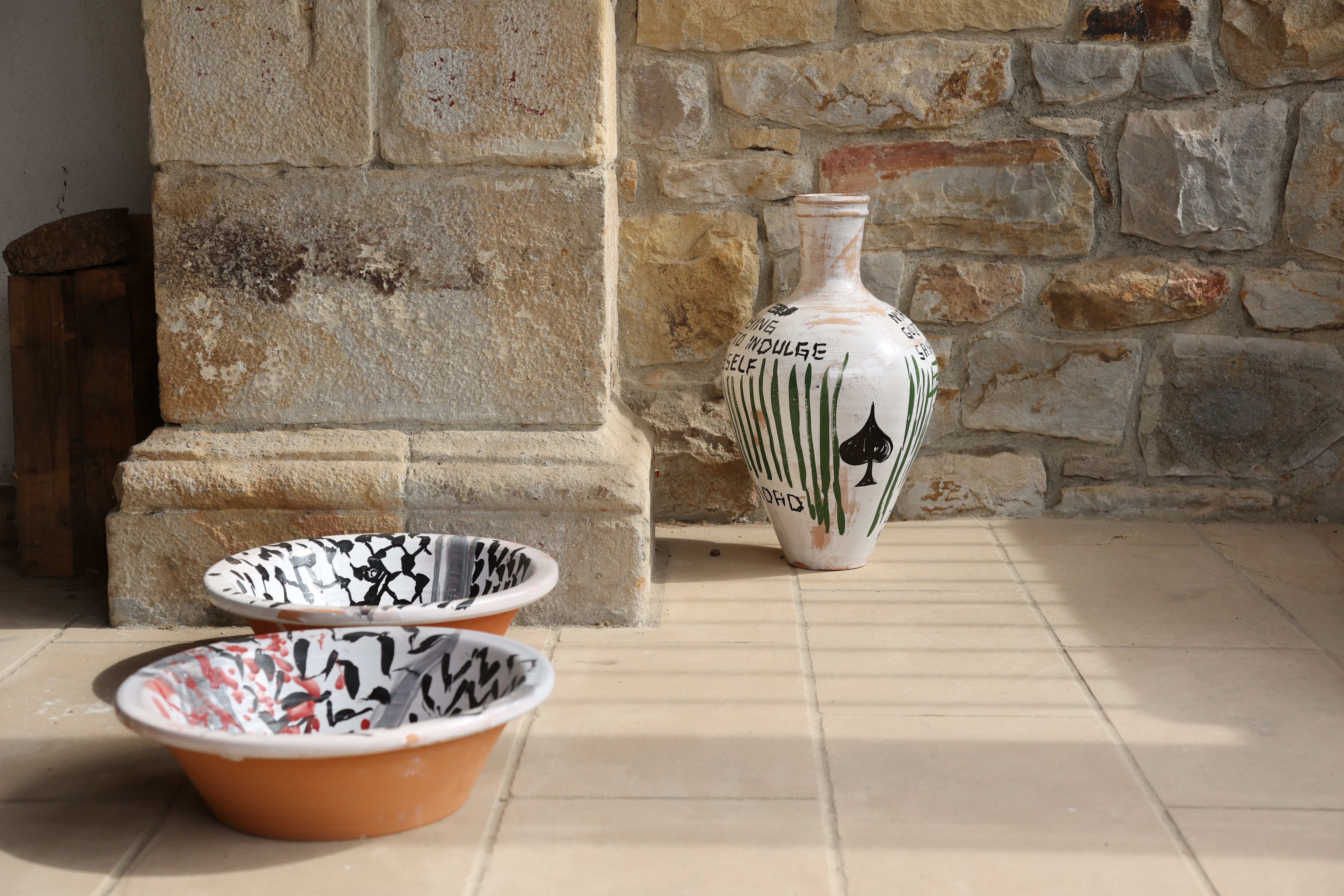
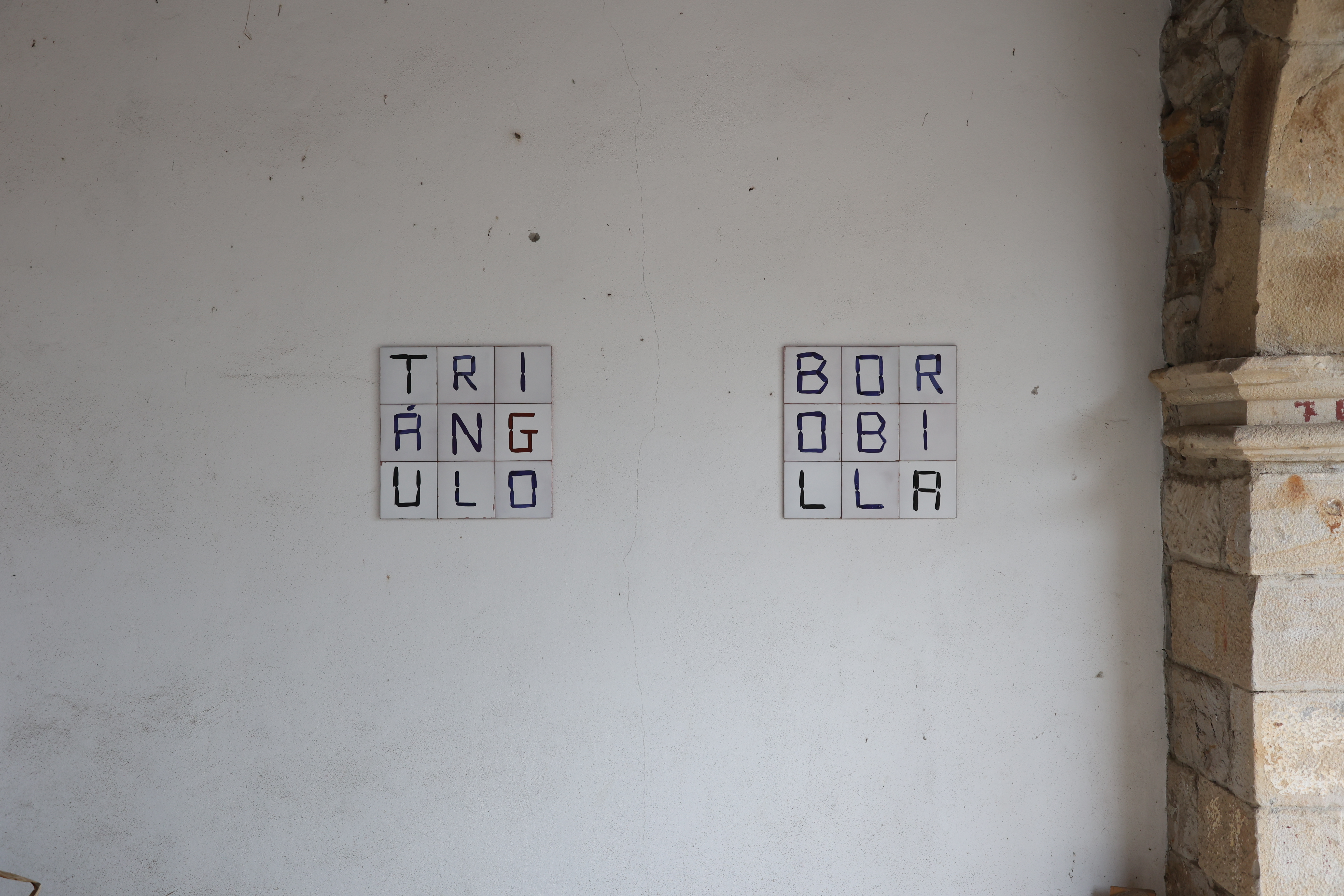
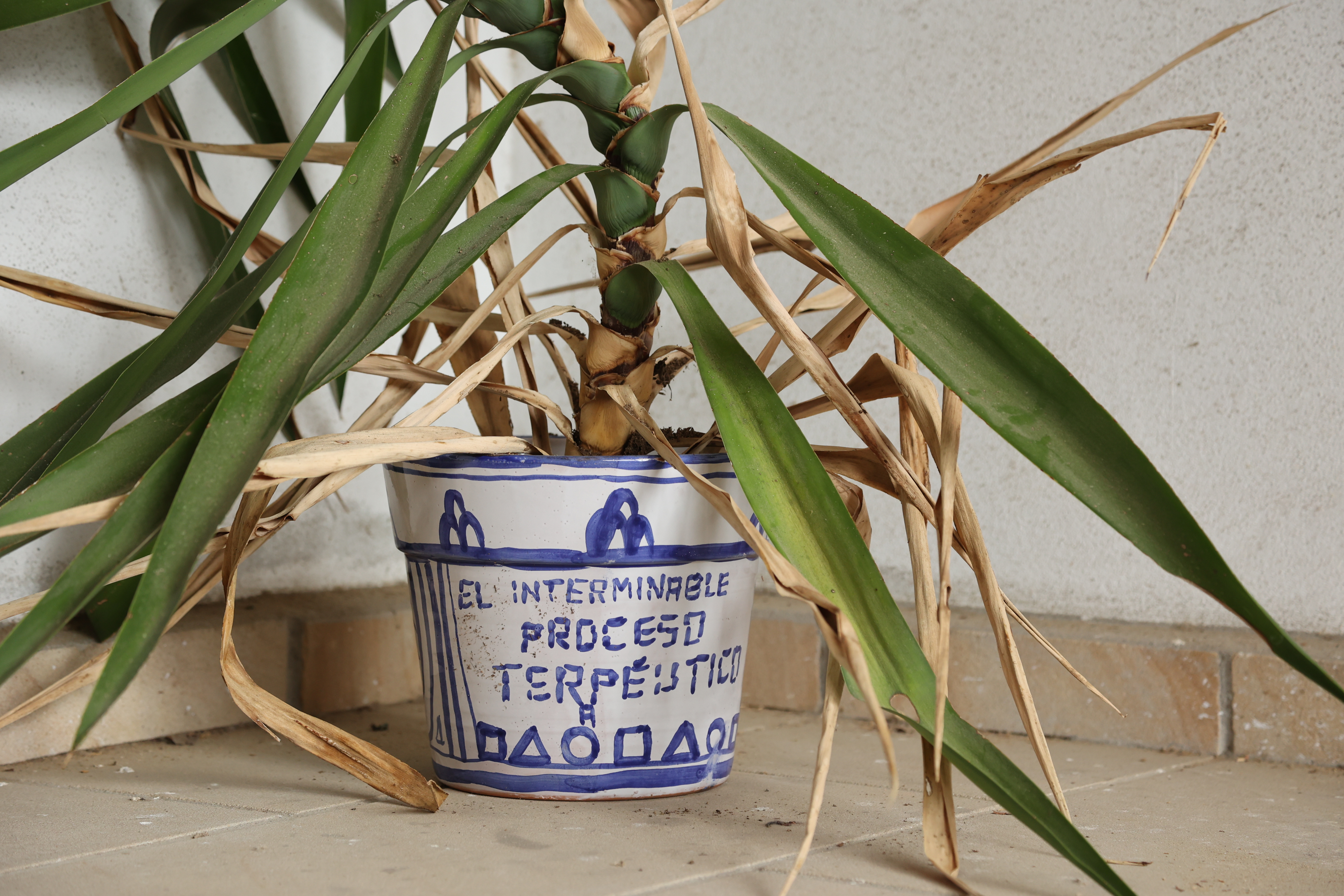
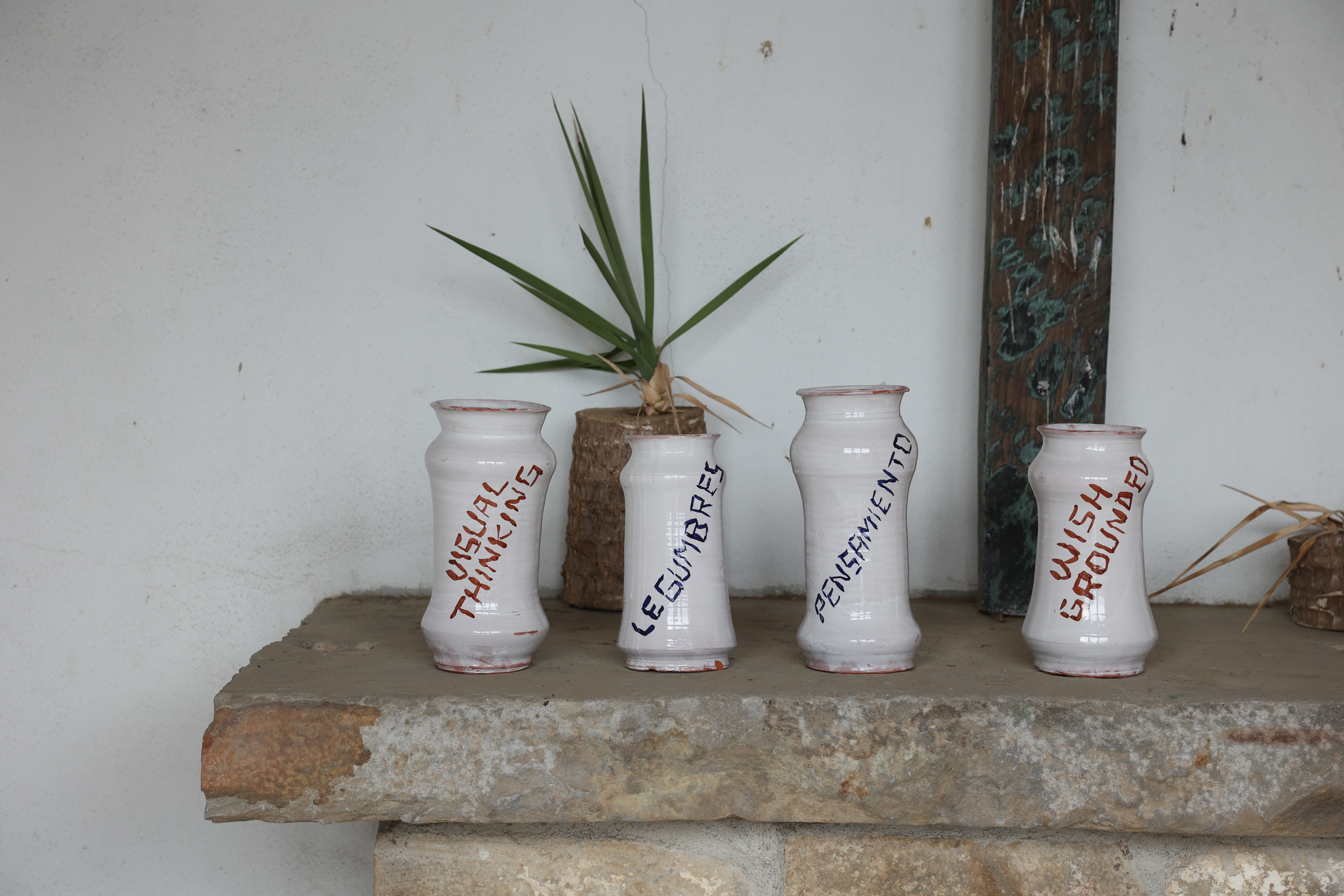
Within this setting, the artist presents a number of pre-existing freestanding ceramic works that function as vessels for drawings and short statements addressing contemporary themes. These works employ a hybrid linguistic approach, alternating between Basque, Spanish and Catalan. Alongside them, two large square-format polyptych mosaics, created specifically for this architectural setting, occupy the lateral walls.
The mosaic on the left completes the phrase that gives the exhibition its title, articulating the artist's critical position through the inscription of the quotation: "Una societat espiritualment lliure és ingovernable" ("A spiritually free society is ungovernable"). Through this gesture, Renes mobilises the historical significance of the site to propose a contemporary reflection on spirituality. Incorporated into the design of the mosaic panels are the Basque words borobila (circle) and triangelua (triangle), direct references to geometric forms that conceptually evoke notions of totality and the Trinity, while remaining articulated through language itself rather than pictorial representation.
Formally, the work is distinguished by its use of an analogue typeface that emulates the aesthetic of digitally generated lettering. The organic surface of the fired clay overlays the visual language of software-based design with the imperfections of the handmade mark, affirming both a historical and symbolic rootedness while reasserting ceramics as the unifying medium of the installation.
Fernando Renes (Covarrubias, 1970) lives and works between Bilbao and Covarrubias. He studied at the Faculty of Fine Arts of the Complutense University of Madrid (1994) and completed a Master’s degree in Research and Creation in Art at the Faculty of Fine Arts of the University of the Basque Country (2017).
His practice began in the 1990s with drawing and animation as his main media. When he returned to Spain in 2014, after 17 years living in New York and Rome, he began working with ceramics, giving his work a three-dimensional and vernacular support.
He has held solo exhibitions at Sala El Brocense, Cáceres (2026); Polvorín de la Ciudadela, Pamplona (2025); Espacio Nexo990, Monzón de Campos, Palencia (2024); MUSAC – Museum of Contemporary Art of Castilla y León, León (2022); UPNA – Public University of Navarra, Pamplona (2021); Fundación BilbaoArte Fundazioa, Bilbao (2019); Centro de Arte Caja de Burgos (CAB), Burgos (2019); Genalguacil Pueblo Museo, Málaga (2024 and 2017); DA2 Salamanca (2015); La Casa Encendida, Madrid (2006); and TRANS>area, New York (2005), among others.
His work is part of the collections of Fundación Botín (Santander), Centre d’art La Panera (Lleida), Fundación Federico García Lorca (Granada), MUSAC – Museum of Contemporary Art of Castilla y León (León), Artium Museum Collection – Basque Government (Vitoria-Gasteiz), and Queens Museum of Art (New York).
He is also featured in publications such as 100 artistas españoles (EXIT, 2008) and Vitamin D: New Perspectives in Drawing (Phaidon, 2005).